


Visit Our Sister Company
855-843-4300
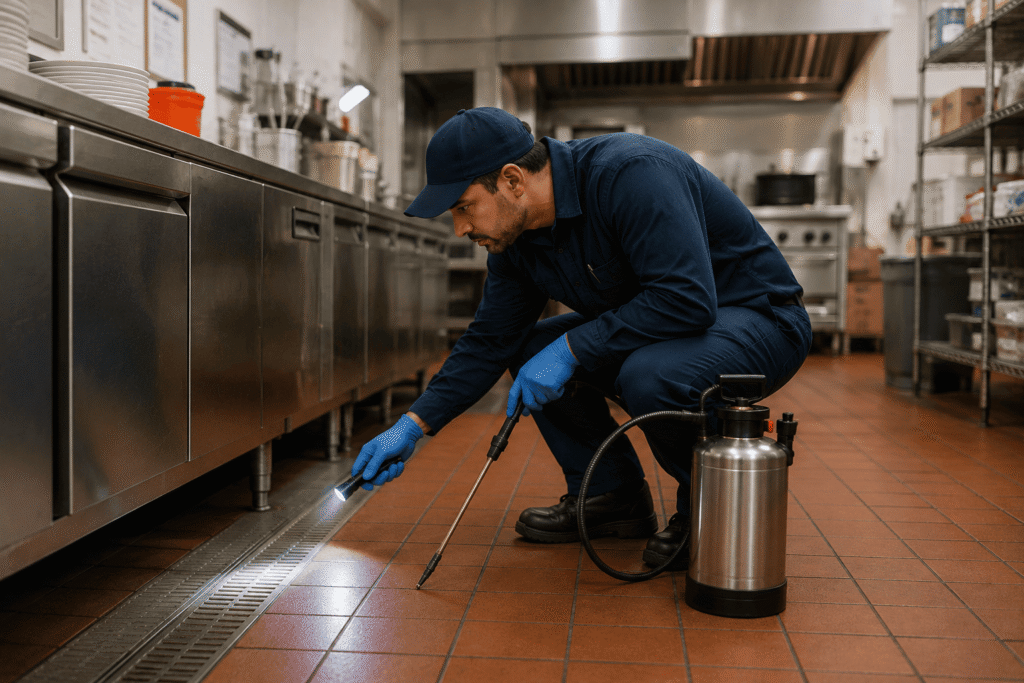
Integrated pest management (IPM) in food service is a prevention-based pest control program that uses inspection, monitoring, exclusion, sanitation coordination, targeted treatment, documentation, and follow-up to reduce pest risk before it becomes an active infestation. The CDC describes IPM as a practical approach built around prevention, reduction, and eliminating the conditions that lead to infestations.
For operations directors, commercial pest control compliance across a multi-location food retail or QSR portfolio is not just a vendor scheduling issue. It is a food safety, documentation, and inspection-readiness problem that has to hold up across every site, every jurisdiction, and every operating condition.
One documented rodent, insect, or sanitation-related pest issue can become a health department matter or a social media event before corporate operations has a complete record.
Food service environments are different because pest control connects directly to food safety. A general commercial site may treat pest activity as a comfort, property damage, or tenant satisfaction issue. In restaurants, grocery, and food retail, pest activity can become evidence of food contamination risk.
The FDA’s FSMA preventive controls rule requires covered food facilities to use a food safety plan with hazard analysis and risk-based preventive controls. Separately, 21 CFR 117.35 states that pests must not be allowed, effective measures must exclude pests from food areas, and pesticide use must protect food, food-contact surfaces, and food-packaging materials.
The FDA Food Code is a model for retail and food service safety that jurisdictions may adopt, which means the national framework may look familiar while enforcement still depends on the local code, inspector, cited condition, and documentation available during the inspection.
Commercial pest control compliance in multi-location food retail and QSR starts with three overlapping requirements: federal food safety, local health code enforcement, and safe pesticide use.
FSMA and current good manufacturing practice language set the prevention mindset for food facilities. The FDA Food Code gives local jurisdictions a model for retail food safety inspections. EPA pesticide labeling rules also matter because pesticide labels are legally enforceable, and pesticides may not be used unless the use is consistent with approved label directions.
For operations directors, compliance cannot live only with the local store manager or regional pest vendor. Corporate teams need a consistent way to verify inspections, findings, corrective actions, and treatment records when an inspector, auditor, or internal risk team asks.
Most pest control compliance failures come from inconsistency across the portfolio. One site may receive routine interior and exterior service, while another gets reactive treatment only after a sighting. One vendor may provide detailed reports, while another leaves a short ticket with little more than a date and signature.
Unresolved site conditions make that inconsistency worse. Conducive conditions are conditions that attract pests or allow them to survive, such as food residue, water sources, structural gaps, cluttered storage, unmanaged waste areas, or harborage near receiving doors. Treating the pest without correcting the condition leaves the same inspection risk in place.


A credible IPM program in food service should show more than recurring chemical application. It should show an operating system with a defined inspection cadence, clear service scope, treatment standards, exclusion work, sanitation coordination, trend review, and corrective action tracking.
How often should inspections occur? The cadence depends on pest history, site conditions, seasonality, local risk, hours of operation, and brand standards. High-risk food service sites often need routine interior and exterior inspection, not just exterior device checks, and the cadence should be explicit rather than left to vendor habit.
Corrective action tracking matters because many fixes sit outside the pest vendor’s direct scope. If a vendor identifies a gap under a receiving door, the record should show who owns the repair, when it was assigned, whether temporary mitigation was used, and when the condition was closed.
Health department inspectors and third-party auditors are not only looking for evidence that a vendor visited the site. They are looking for a documentation chain that connects service activity to food safety control, pesticide-use rules, and corrective action follow-through.
The difference between ordinary documentation and audit-ready documentation is retrieval. A vendor may produce records somewhere. An audit-ready program can produce the right record quickly, in a consistent format, with enough detail to support the site’s compliance position.
A national facilities partner can reduce exposure by turning pest control from a local vendor relationship into a standardized operating program. The value is shared standards, consistent reporting expectations, centralized documentation, and escalation paths that do not depend on one manager chasing five vendors.
Integrated facilities management can also support compliance coordination across related scopes. Pest control may be the trigger, but the fix may involve fire safety compliance, HVAC repair, janitorial response, plumbing, waste removal, or exterior maintenance. Coordinating those services through one operating model reduces the chance that each vendor documents its own task while the underlying condition stays open
How does each vendor define inspection cadence for high-risk food service locations?
Can every location produce current service reports, chemical use logs, pest sighting records, and corrective action records during an inspection?
How are conducive conditions assigned, escalated, repaired, and verified across the portfolio?
What centralized reporting shows repeat pest activity, unresolved site conditions, missed service windows, and inspection readiness by location?
How are pest control findings coordinated with janitorial, waste, HVAC, plumbing, fire safety, and exterior maintenance scopes when the fix sits outside the pest vendor's lane?
For multi-location food retail and QSR operators, the question is not whether to invest in a compliant pest control program. It is whether the current vendor program executes consistently enough to be audit-ready at every location, every inspection cycle.
That consistency is what a national facilities partner is built to deliver: standardized execution, centralized documentation, clearer escalation, and a portfolio-level view of risk before pest activity becomes a regulatory, operational, or brand event.